
Partial truth:
We need data centers for our internet (Cloud Services: streaming, socials, banking…)
Whole Truth:
Hyperscale Data Centers are for AI.
Small scale data centers are for Cloud Services.
In 2030 70% of data center workload will be for AI
— The future of AI workloads | McKinsey & Company | 24 Feb, 2026
Partial truth: New cooling technologies "sip" water.
Whole Truth:
Yes, Hyperscale systems are moving toward more water efficient operations.
Water efficiency requires more electricity - and power generation uses a lot of water.
Patrial Truth:
Consumers are protected from rate increases.
Whole Truth:
We pay bills not rates
We are not protected from costs (Georgia Power has frozen rates; rates don’t cover changing fuel costs nor gas pipeline expansion)
Frequently Asked Questions
-
Regular datacenters are where the cloud resides. They hold your photos, streaming services, cloud backups, etc. They are as old as the internet and were of little worry to communities, as they were just there, in the background.
AI Hyperscale data centers are a specialized type of data center that houses compute-intense equipment to support Artificial Intelligence (AI). These large structures take up hundreds of acres and can use about the same amount of electricity as half of Hoover Dam or one commercial nuclear reactor. -
Mainly temporary construction jobs:
“If you’re an electrician, you’re a plumber, a carpenter—we’re going to need hundreds of thousands of them to build all of these factories,”
CEOs agree: It's out with the white-collar jobs, in with the blue-collar
-
Everywhere!
-
Georgia has cheap land, power, and water. It has excellent internet connectivity.
Georgia offers a set of tax breaks, that cost the state $2.5 Billion in 2026 alone.
Economic Development Authorities and the GA Chamber of Commerce are asking them to come.
-
Everything! Georgia Power is proposing to almost double it’s power generation output, mainly via gas turbines, to serve data centers.
The costs may or may not be passed to you. It is under investigation.
Currently, the expansion of gas pipelines to serve the gas turbines to power the data centers - is going to be passed to consumers.
-
Most data center deals are made between the data center company and the county or city via their local economic development authority. These deals are usually made under “Non-Disclosure Agreements (NDAs)” - and data center companies claim that everything including power, water, taxes, jobs, etc are a “trade secret.”
Video Library
Introduction to Data Centers
- Amy Sharma, PhD, Science for Georgia
In Depth Explanations
-
Community Benefit Agreements are legally binding agreement that make sure promised benefits materialize.
Learn more here: Community Benefits Framework — Georgia WAND
-
Ordinances are the local codes that cover where the data center can go and all the rules it must follow.
-
Data centers can impact local economies, the health of humans and animals, and the local environment. Learn more about those impacts here.
-
From them American Public Health Association: Data Centers and Public Health
Chattahoochee Riverkeeper Policy Director, Chris Manganiello, shares information on the impacts of data centers on water and water quality and potential mitigations.
Impacts on Water
Data Centers require water for two things:
On site - to cool the equipment
Off site - to generate power via coal and gas energy generation
A “closed loop” cooling system may require little on-site water, but it uses more energy. Where is the power to run the data center going to come from?
It is important communities ask about:
Regardless of cooling system type: how much water will be consumed?
What is the plan for emergencies (i.e. during a drought or natural disaster)?
Wastewater. What is in it? How often will it be tested? Is the local water treatment facility equipped to handle the wastewater contents?
-
Data center facilities shall comply with the local floodplain management ordinance, as applicable, and shall not be permitted within the floodway.
Evaporative cooling systems requiring any water replacement in excess of ten percent of system capacity within any twelve-month period are not permitted in [X County]. Closed-loop cooling systems or its equivalent, shall be the preferred standard for operational cooking limiting its water consummation in order to protect local water resources and preserve long-term water availability for residents, agriculture and existing industry, Alternative cooling methods may be permitted only by a variance approval upon demonstration by the applicant that such methods achieve water conservation, efficiency, and environmental protection, as determined by the governing authority and applicable regulatory agencies. Any approved alternative cooling method must minimize water consumption, protect local water resources, and comply with all federal, state, and local environmental regulations, including by not limited to, applicable Georgia Environmental Protection Division and US. Environmental Protection Agency standards
Information related to water usage by the high resource use facility, including:
The sources of water used in the facility, including, but not limited to, rain water, treated water, well water, on-site reservoir, and gray water;
The amount of water used annually measured in gallons;
The mean amount of water used daily measured in gallons;
The annual amount of water discharged daily as wastewater measured in gallons;
The annual amount of water emitted into the environment measured in gallons; and
The quantity in gallons and method of pretreatment of water being discharged to a permitted wastewater disposal system, if any, to remove pollutants or change the water temperature before being discharged or emitted into the environment;
Water consumption plan: the plan will
Outline the total water requirements—including daily demand, daily wastewater generation, and daily consumptive use—of the data center, including for cooling and other purposes.
Outline the water needs as they correspond to the phasing of construction.
Indicate that the [city/county/regional water supplier] has been consulted.
Stormwater management plan. addressing how the site’s development, land disturbance, construction, and operation will manage stormwater runoff, as well as any mitigation measures to prevent negative impacts on waters of the state and local water system infrastructure.
Water conservation and sustainability plan:
Must demonstrate that the water usage will not significantly strain the [city/county] and region’s water supplies from the [XX River/Creek/Lake/Aquifer] and other sources.
Will include measures, strategies, techniques and technologies that will reduce the consumption of water, reduce the loss or waste of water, improve the efficiency in the use of water, or establish use of reclaimed water by the large quantity water user.
Will detail the facility’s methods to reduce water demands and alter operations in the event of a water disruption, a significant drought event affecting water supplies for critical facilities, or emergency periods of water shortage.
Lifetime water and wastewater testing plan. In conjunction with the local water authorities, create a plan to test surface, ground, and wastewater during construction and operation of the facility. This plan shall address frequency, location, and testing authority.
The video above features - Dr Anne Mellinger-Birdsong, Medical and Health Advisor, Mothers & Others for Clean Air, covering the impacts of poor air quality on human health.
Impacts on Air Quality
A recent study found that regular testing of on-site backup power generators creates the same public-health impacts as running a large gas-fired power plant. Poor air quality can lead to asthma, cancer, and other chronic illnesses.
Data Centers impact air quality mainly via on-site power generation. It is important communities understand and regulate the following about power generation:
Is the power-generation backup only? Or will it be on-site and run 24 hours a day / 7 days a week?
When will backup power generators be tested? (Testing times should be limited to weekdays and only occur once a month)
What air quality standards will the generators have to abide by? (EPA Tier IV or better is recommended)
-
•Energy consumption plan: outlining estimates of peak electricity demand and strategies for mitigating strain on local power infrastructure, including proposed investments, improvements or alternatives to minimize the need for additional energy infrastructure.
•Power source plan: A description of any power sources proposed to be constructed or sited and operated, including emissions profile, noise, copies of applications for any required state or federal air permits.
•Power Capacity Verification. Documentation, including written verification from the applicable service providers, demonstrating that: Public utility capacity and related electrical infrastructure sufficient in size and capacity is or will be made available to ensure that the power requirements of the proposed project can safely be accommodated without adverse effect on the availability, reliability, quality, cost, or safety of the electric service to other customers.
•Transmission line impact assessment: identifying the need for new or upgraded transmission lines to meet the data center's electricity requirements. This assessment must include the potential environmental impact on public or private land, including tree removal from city-owned land and rights-of-way, and on adjacent properties.
•Normal Power Operation. Except for generator testing or commissioning activities, generator use shall be limited to backup and emergency use only when the primary source of electricity is interrupted or unavailable. Continuous generator use outside of power outages or interruptions is prohibited.
•Backup Power Generation
•The initial source of backup power generation shall be a battery energy storage system (BESS) to meet the needs of four hours of outage.
•Backup generators and other equipment shall be considered a fixed source and must comply with all applicable GA EPD and federal air quality regulations.
•Generators must be low emission, meeting, at a minimum, EPA Tier IV (or the highest Environmental Protection Association industry standard available at the time of application) which meet all applicable local, state, and federal emission and performance standards to minimize adverse effects from the generator emissions.
•Generators shall be tested no more than twice per month per unit, for a thirty-minute duration, and only during the hours of 12 P.M. to 5 P.M. Monday through Friday and never on Federal Holidays.
-
Mothers & Others For Clean Air links
EPD links about permits:
EPD also has similar pages for land announcements, and for water announcements for companies that submit forms and apply for permits
Dr Evan Mallen, Principal, Urban Adapt LLC, provides information on the impact of heat on our health and our environment.
Resources mentioned in his talk:
Urban Heat + Health - Atlanta Climate Vulnerability Map
Federation of American Scientists - Before Breaking Ground Guide
Heat.gov
Impacts oF Heat
Data Centers and any other large impervious surface (parking lots, warehouses, etc) create “heat islands” - where they raise the temperature of the surrounding environment. Data Centers are even worse than parking lots, because their internal equipment produces even more heat.
Many health conditions are worsened by increased heat, and this puts vulnerable populations like young children and the elderly, especially at risk. It also has an outsize impact on those working primarily outdoors, such as construction workers, agricultural laborers, and utility personnel (WHO).
Planting trees and installing green roofs can have a mitigating impact, as well as increased buffers and setbacks that have greenery or vegetation.
Impacts of Noise
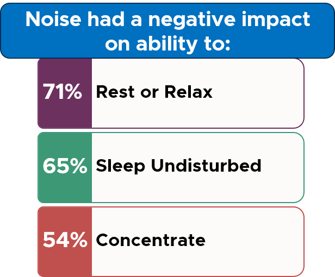
A recent survey by Science for Georgia and Quiet Communities found that 76% of people that live over one-half a mile away can still hear the sound inside their homes.
Read the full survey and results here: Negative Noise Impacts from Data Centers and Cryptomines
-
At the city/county ordinance level:
Increased buffers and setbacks – a half-mile is over 2500 feet, many recommended buffers are 500 feet.
Limits in both dBA and dBC (dBC is for the low-frequency hum)
Regular mandated testing at both
Property line
Half mile away
Ordinance language:
Between 9:00 p.m. and 7:00 a.m., the data center shall not generate noise in excess of 40 dB(A) or 10dB(A) above ambient levels (whichever is more), and 65 dB(C), when measured at the property boundary line shared with a residentially zoned property using a calibrated sound level meter.
Between 7:00 a.m. and 10:00 p.m., the data center shall not generate noise in excess of 50 dB(A) or 10dB(A) above ambient levels (whichever is more), and 70 dB(C) when measured at the property boundary line shared with a residentially zoned property using a calibrated sound level meter. For data centers located within 500 feet of any allowed residential use or district, place of worship, daycare, park, lodging establishment (including bed and breakfast inn, campground and recreational vehicle park, hotel and motel, nightly rental, and timeshare unit), and educational facilities, the SPL attributable to the facility shall not exceed fifty (50) dBC at all data center property line.
Noise evaluation report and mitigation plan.
A noise evaluation and sound modeling report for each data center facility, substation or other associated facility that emits noise in the project. The report shall state, at minimum, the daytime and nighttime base-line noise level at a point on the property line closest to the primary dwelling on an adjoining non-participating parcel; the potential noise level generated by each data center facility, substation or other associated facility associated with the project; and the manufacturer’s technical documentation for each data center facility, substation or other associated facility equipment noise levels. The noise evaluation report shall include the projected maximum levels of high and low frequencies: projected maximum levels of infrasonic sound, ultrasonic sound, impulsive noise and prominent discrete tones generated and measured at a point on the property line closest to the primary dwelling on an adjoining nonparticipating parcel. The report shall include a map depicting the noise study area radius, project boundaries, sound level monitoring locations and the nearest receptor locations
The noise mitigation plan shall include any potential mitigation actions to ensure that sound level does not exceed 40 dBA and 50 dBC as measured at the property line point(s)
Lifetime noise testing plan. Create a plan to monitor noise levels during construction and operation of the facility. This plan shall address frequency, location, and testing authority.
Noise pollution is not just a nuisance. It can have a negative impact on
Children’s ability to learn
Adult’s ability to earn a living
Animal Life: Communication, eating habits, and reproduction
It pushes the body’s stress response into overdrive: increase the risk of heart disease, stroke, depression, and even early death
It creates Sleep Disturbances with impact mood, focus, and long-term physical and mental health.
Animals
Dr Michelle Wooten, an assistant professor of astronomy at Univ of Alabama Birmingham, and leader of Starry Skies South, shares information on the impacts of light pollution on human and animal health.
Light POllution Impacts
Light pollution is a modern-day problem. Yet - it is more than just an annoyance - it impacts human, animal, and plant health: from impacted sleep patterns, to changed feeding habits, to throwing birds off course, and causing plants to bloom off cycle.
Data centers have the potential to produce a lot of light pollution - but there are regulatory fixes.
-
Lighting
1. Lifetime lighting testing plan. Create a plan to test lighting compliance. This plan shall address frequency, location, and testing authority.
1. All lighting shall be activated by motion sensors, be fully shielded, and be designed to maintain the existing night sky darkness and to prevent light trespass onto adjacent properties and streets.
-